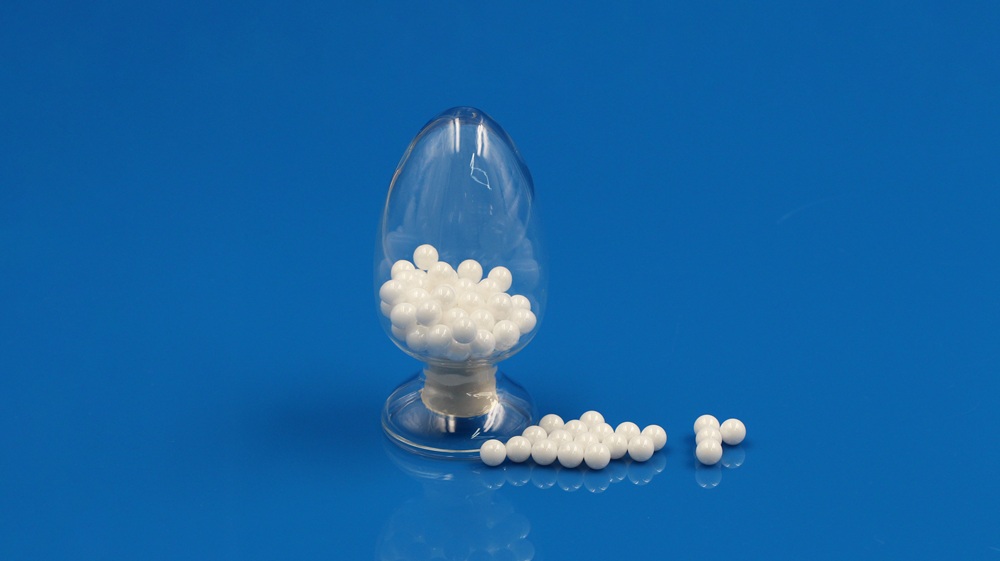
Zirconia beads are high-performance grinding media manufactured from zirconium oxide (ZrO₂) and densified through high-temperature sintering. They combine high hardness (Mohs hardness of approximately 8.5), high density (5.6–6.0 g/cm³), extremely low wear rates (typically below 50 ppm/h), and excellent chemical stability across a wide pH range of 1–14. These characteristics make zirconia beads an ideal choice for coatings and paint processing, helping manufacturers improve grinding efficiency, increase solid content, optimize product performance, and reduce overall production costs.
Advantages of Zirconia Beads in Coating and Paint Grinding
1. Improving Processing Efficiency
Due to their high density and superior impact energy, zirconia beads transfer grinding energy efficiently and promote rapid particle size reduction. This leads to shorter milling times, more uniform particle dispersion, and improved production efficiency. In UV-curable and electron-beam-curable coating systems, improved dispersion can also contribute to more consistent curing behavior and better rheological control.
2. Lower Maintenance and Rework Costs
Zirconia beads exhibit excellent wear resistance and maintain their shape even during extended operation. Their low wear characteristics minimize contamination and support the production of coatings with improved scratch resistance and durability. As a result, coating systems generally require fewer repairs and less frequent recoating, reducing both maintenance costs and downtime.
3. Enhancing Durability and Barrier Performance
The highly spherical geometry of zirconia beads promotes dense particle packing and more uniform dispersion within coating formulations. This contributes to coatings with improved compactness and lower permeability. In addition, the chemical inertness of zirconia provides effective resistance against moisture, heat, salt spray, and various corrosive environments, helping extend coating service life.
4. Improving Flow Characteristics
The high density and smooth spherical surfaces of zirconia beads allow them to move efficiently within the milling system. During grinding, they facilitate better material flow and dispersion, helping formulate coatings that are easier to process and apply while achieving smoother spraying performance.
5. Supporting Gloss Control
Many conventional matting additives tend to increase formulation viscosity while reducing gloss. Zirconia beads can help achieve desired gloss levels through efficient particle dispersion, often with less impact on viscosity, thereby providing greater flexibility in formulation design.
6. Increasing Solid Content and Reducing Costs
Because spherical particles have a relatively low surface-area-to-volume ratio, formulations using zirconia beads can achieve higher filler loading while requiring less resin. Fine zirconia microspheres can also occupy the spaces between larger particles, increasing packing density and solid content. This approach can contribute to lower VOC levels and improved cost efficiency in coating production.
Conclusion
With their combination of high hardness, low wear, chemical stability, and excellent grinding performance, zirconia beads have become an important grinding medium for modern coating and paint manufacturing. By improving dispersion efficiency, enhancing coating properties, and supporting more economical production processes, zirconia beads provide a practical solution for manufacturers seeking higher productivity and more consistent product quality.