In modern chemical processing, petrochemical production, environmental protection, and gas-liquid mass transfer, packed towers are widely used to improve contact between gases and liquids and maintain stable process operation. As one of the key internal components, ceramic tower packing offers excellent resistance to acids, alkalis, high temperatures, and chemical attack, making it particularly suitable for demanding industrial environments.
Compared with metal and plastic packing, ceramic packing is less susceptible to corrosion, aging, deformation, and thermal damage. Its stable performance and long service life can help reduce maintenance frequency and component replacement costs, making it a practical choice for continuous industrial operation.
I. What Is Ceramic Tower Packing?
Ceramic tower packing is a type of ceramic component manufactured from high-alumina raw materials through high-temperature sintering. Installed inside packed towers, it increases the effective contact area between gas and liquid and helps improve fluid distribution throughout the tower.
Depending on the design, ceramic packing can support gas-liquid mass transfer, heat exchange, material separation, and catalyst bed protection. Its structure also affects pressure drop and flow behavior, so the appropriate packing type should be selected according to the specific process requirements.
Ceramic tower packing is commonly used in:
- Distillation towers
- Absorption towers
- Gas washing and scrubbing towers
- Flue gas treatment systems
- Chemical reaction towers
- Catalyst support beds
These applications are commonly found in the chemical, petrochemical, environmental protection, and fine chemical industries.
II. Common Types of Ceramic Tower Packing
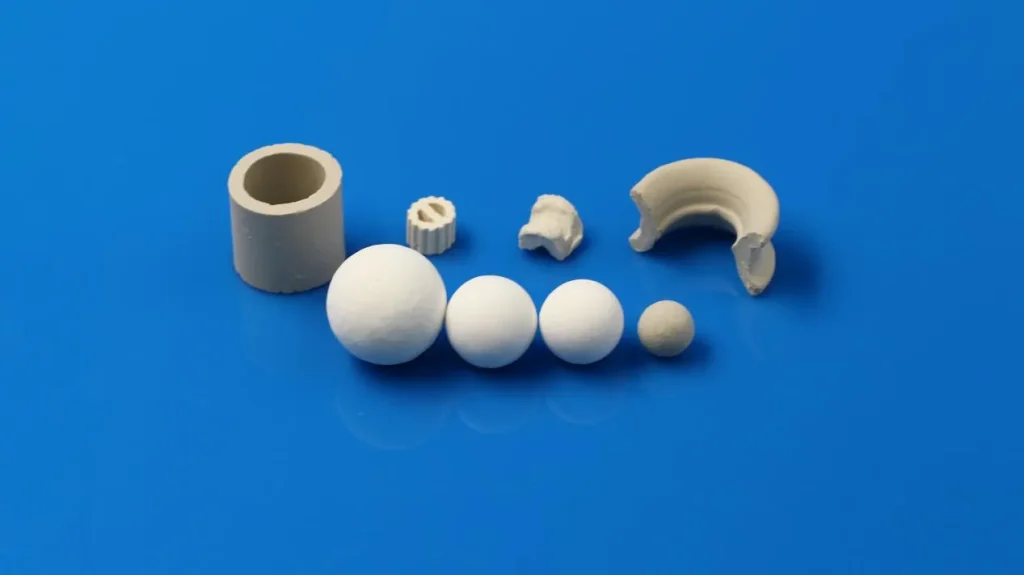
Different packing structures provide different combinations of contact area, flow capacity, pressure drop, mechanical strength, and liquid distribution. The main types used in industrial applications include the following.
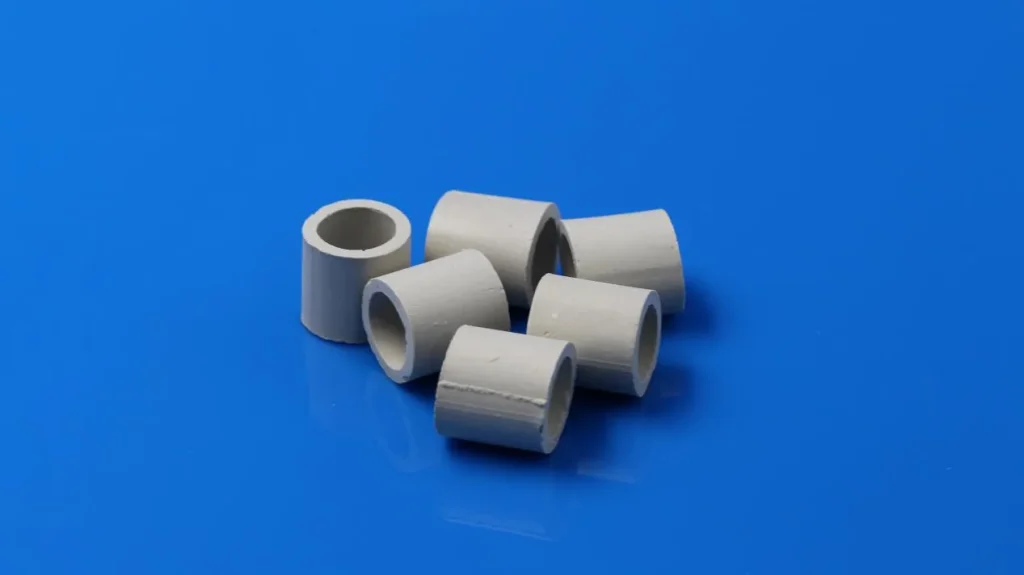
1. Ceramic Raschig Rings
Ceramic Raschig Rings are one of the classic forms of random tower packing. Their simple cylindrical structure provides relatively low manufacturing costs and broad application flexibility.
They are commonly used in conventional gas washing towers, pretreatment systems, and existing chemical towers requiring refurbishment or replacement of packing.
However, compared with more advanced designs, the simple ring structure provides less effective fluid distribution. Under certain operating conditions, channeling and relatively high pressure drop may occur.
2. Ceramic Pall Rings
Ceramic Pall Rings are an improved version of traditional Raschig Rings. Open windows are incorporated into the ring walls, while internal sections extend toward the center of the ring.
This open structure creates additional pathways for gas and liquid flow, improving circulation through the packing and increasing the effective contact area. Compared with conventional Raschig Rings, Pall Rings can provide better mass-transfer performance, lower pressure drop, and greater flow capacity under suitable operating conditions.
They are widely used in chemical absorption, stripping, and degassing processes.
3. Ceramic Intalox Saddle Rings
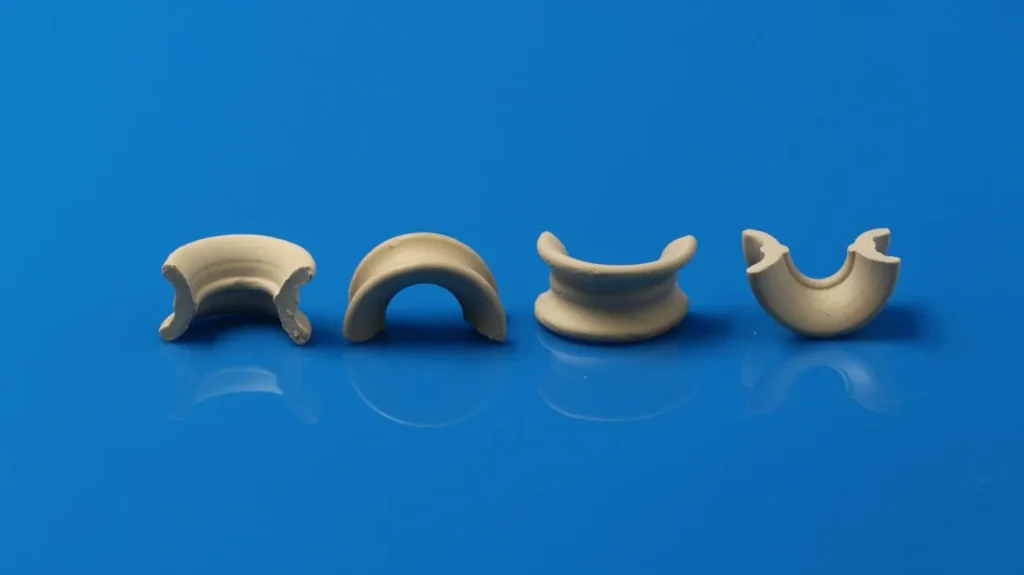
Ceramic Intalox Saddle Rings, also known as ceramic saddle rings, feature a curved saddle-shaped structure with high void volume and relatively uniform packing characteristics.
The geometry helps promote more even liquid distribution while reducing wall flow and localized channeling. It also provides good gas-liquid contact and high flow capacity.
Because of their resistance to high temperatures and corrosive media, ceramic saddle rings are commonly used in sulfuric acid drying towers, flue gas desulfurization systems, and acidic gas scrubbing equipment.
4. Ceramic Cross Partition Rings
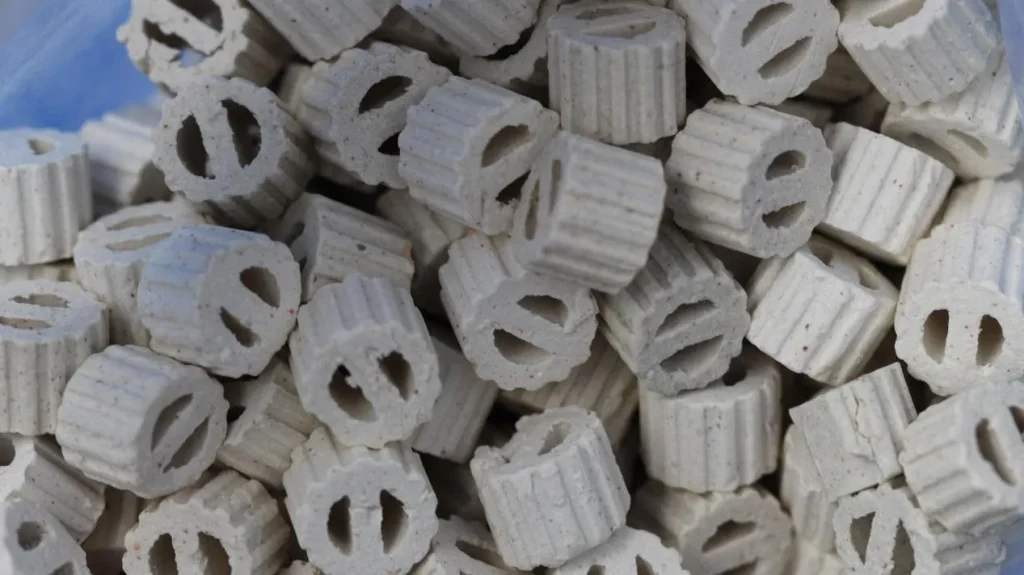
Ceramic Cross Partition Rings incorporate internal cross partitions within the ring structure. These partitions divide the internal space into multiple flow paths, increasing the interaction area between gas and liquid.
The regular structure also provides good mechanical strength and compressive resistance. These packing components can be used for mass transfer or as support packing, particularly in large-diameter industrial towers where structural stability is important.
5. Ceramic Packing Balls
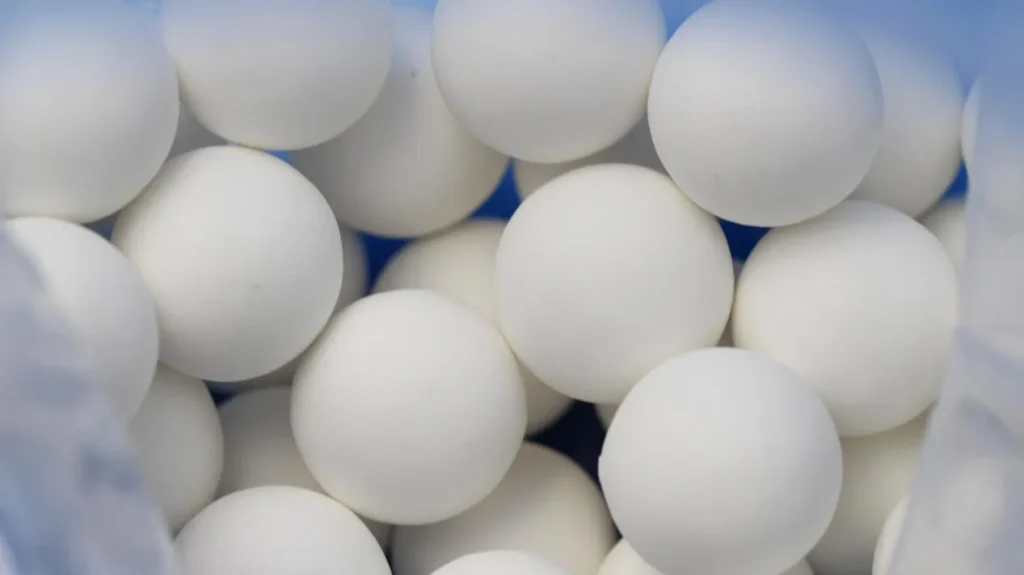
Ceramic packing balls are generally available in solid inert ceramic balls and perforated ceramic balls.
Their dense ceramic structure provides good compressive strength, wear resistance, and chemical stability. In fixed-bed reactors, they are often installed above or below catalyst beds to provide support and help distribute gas flow.
They can also buffer material impact, reduce direct mechanical loading on the catalyst, and help prevent larger impurities from entering the catalyst bed.
Ceramic packing balls are widely used in petrochemical, fertilizer, and fine chemical reaction systems.
III. Comparison of Different Ceramic Tower Packing Types
| Packing Type | Core Advantages | Relative Pressure Drop | Mass Transfer Efficiency | Application Scenarios |
|---|---|---|---|---|
| Ceramic Raschig Ring | Low cost, stable structure, high versatility | Relatively high | Medium | Rough washing towers, pretreatment towers, old tower renovation, conventional separation processes |
| Ceramic Pall Ring | Smooth fluid circulation, low resistance, high mass transfer efficiency | Relatively low | Relatively high | Gas absorption, degassing, rectification, medium-precision separation processes |
| Ceramic Intalox Saddle | Uniform liquid distribution, large flux, anti-clogging | Low | High | Flue gas desulfurization, sulfuric acid process, waste gas washing, high-flow working conditions |
| Ceramic Cross Partition Ring | Large contact area, high compression resistance, excellent supporting performance | Medium | Relatively high | Tower bottom support, high tower section mass transfer, large-diameter industrial towers |
| Ceramic Packing Ball | Wear- and compression-resistant, uniform flow distribution, catalyst protection | Extremely low | Auxiliary mass transfer | Catalyst bed support, bedding protection, uniform fluid distribution |
IV. Main Application Areas of Ceramic Tower Packing
The combination of high-temperature resistance, chemical stability, and corrosion resistance allows ceramic tower packing to be used across a wide range of industrial processes.
1. Chemical and Fine Chemical Processing
Ceramic packing is used in distillation, absorption, stripping, and gas-treatment systems involving corrosive media. Typical applications include hydrochloric acid, nitric acid, and sulfuric acid production towers, as well as other separation processes involving strong chemical environments.
2. Petrochemical Processing
In petrochemical applications, ceramic packing can be used in gas washing, tail-gas treatment, desulfurization systems, and catalyst-support structures. Its resistance to heat and chemical attack makes it suitable for demanding oil and gas processing conditions.
3. Industrial Waste-Gas Treatment
Ceramic packing is commonly used in flue gas desulfurization towers, chemical VOC washing systems, acid-gas treatment equipment, and industrial acid/alkali waste purification systems.
4. Highly Corrosive Process Environments
Processes involving wet metallurgy, acid washing, chlorine-alkali production, and inorganic acid processing often require packing materials with strong resistance to corrosive media. Ceramic packing can maintain stable performance in these demanding environments.
5. Catalytic Reaction Systems
In fixed-bed reactors used for fertilizer, petrochemical, and fine chemical production, ceramic packing balls can provide catalyst support, assist with gas distribution, and help protect the catalyst bed from direct mechanical impact.
V. How to Select the Right Ceramic Tower Packing
The most suitable ceramic packing depends on the actual tower design and operating conditions rather than the packing material alone.
Key factors to consider include:
- Gas and liquid flow rates
- Operating temperature
- Chemical composition and corrosiveness
- Required mass-transfer performance
- Pressure-drop requirements
- Tower diameter and internal structure
- Catalyst support requirements
- Expected service life
Different packing geometries provide different flow and mass-transfer characteristics, so the selection should be matched to the specific process rather than based solely on appearance or material.
VI. Conclusion
Ceramic tower packing is an important component in industrial gas-liquid mass transfer, separation, purification, and catalytic support systems. Its combination of high-temperature resistance, chemical stability, corrosion resistance, and long-term durability makes it particularly suitable for demanding applications in the chemical, petrochemical, and environmental industries.
INNOVA Supplies provides a range of ceramic tower packing solutions, including customized non-standard dimensions and high-alumina ceramic materials. Packing designs can be developed according to tower dimensions, process requirements, operating temperature, chemical media, and other application conditions.
For new tower projects, packing replacement, or customized ceramic components, INNOVA Supplies can provide suitable ceramic packing solutions based on your specific operating conditions and technical requirements.