Reliable ignition is essential for gas-fired heating equipment, including hot water boilers, gas pool heaters, and other burner-based systems. When the equipment receives a heating demand, its control system initiates a preset startup sequence involving air supply, gas delivery, and ignition. Once combustion is established, the burner transfers heat to the water through a heat exchanger.
A ceramic igniter is responsible for initiating combustion rather than heating the water directly. During startup, it quickly reaches the temperature needed to ignite the gas, allowing the burner to begin operating.
As gas-fired appliances continue to develop toward higher efficiency, more compact designs, and automated operation, silicon nitride ceramics are increasingly used in hot-surface ignition systems for gas boilers, burners, and pool heaters. Their fast thermal response, good resistance to thermal shock, and reliable mechanical performance at high temperatures make them suitable for these applications.
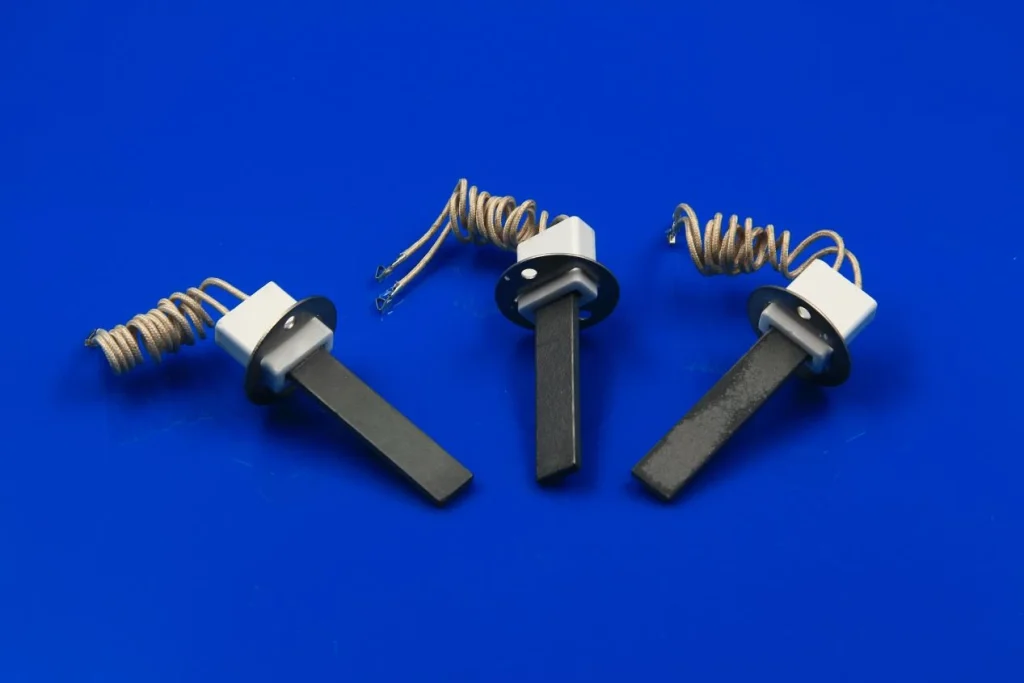
Silicon Nitride Ceramic Igniters
1. How Does a Ceramic Igniter Work in a Gas-Fired Hot Water Boiler?
In a gas-fired hot water boiler, the heat comes from burning gas, not from the ceramic igniter. When the system detects a demand for heating, the control unit starts the combustion process according to its programmed sequence.
In equipment that uses hot-surface ignition, the ceramic igniter is energized first and begins to heat up. Once its heating area reaches the required ignition temperature, gas is introduced into the combustion chamber and ignited by the hot surface.
After combustion becomes stable, the heat generated by the burner passes through the heat exchanger and is transferred to the circulating water. This process supports different heating functions, including domestic hot water production, space heating, and pool water heating.
Although the igniter is a relatively small component, its performance has a direct bearing on the startup process. In gas appliances with automatic start-stop operation, factors such as heating speed, installation position, and compatibility with the burner all need to be considered to ensure reliable ignition.
2. Why Is Silicon Nitride Used in Hot-Surface Igniters?
A hot-surface igniter must reach the required ignition temperature within a short period and withstand repeated heating and cooling throughout its service life. Reaching a high temperature alone is not sufficient. The material must also maintain its performance under repeated thermal cycling.
Silicon nitride is an engineering ceramic valued for its high-temperature mechanical properties and resistance to thermal shock. These characteristics make it a suitable material for compact ceramic igniters used in combustion equipment.
2.1 Fast Thermal Response
During equipment startup, the igniter must reach the required ignition temperature within the time allowed by the control system. Silicon nitride ceramic heating elements can be designed to provide a fast thermal response, supporting the automatic ignition sequence of gas burners.
2.2 Resistance to Thermal Shock
Gas-fired appliances may undergo frequent start-stop cycles during normal operation. Each cycle exposes the igniter to rapid heating and cooling, placing repeated thermal stress on the component.
Silicon nitride’s good thermal shock resistance helps it withstand these temperature changes, making it suitable for applications involving frequent thermal cycling.
2.3 High-Temperature Mechanical Performance
A ceramic igniter is typically installed close to or directly within the combustion area. In addition to exposure to high temperatures, its structure must withstand the demands associated with installation, repeated thermal cycling, and long-term operation.
Silicon nitride offers good mechanical properties at elevated temperatures, helping meet the structural requirements of igniters used in combustion systems.
2.4 Compact Heating Element Design
Gas boilers and burners often have limited internal installation space. The igniter must therefore deliver the required heating output without exceeding the available dimensions.
Silicon nitride ceramic heating elements can be manufactured in compact geometries to accommodate the space limitations and structural requirements of different burner designs.
3. What Should Be Considered When Selecting an Igniter for a Premixed Gas Burner?
In a premixed combustion system, gas and air are mixed at a specified ratio before entering the burner for combustion. During startup, the fan, gas supply, igniter, and control system must operate in coordination according to the equipment’s preset sequence.
For this reason, selecting a ceramic igniter for a premixed burner involves more than checking whether its voltage and power ratings match the equipment.
The heating area must be correctly positioned relative to the burner so that gas can be ignited reliably. Its dimensions and mounting structure must also fit the available installation space. Other parameters, including operating voltage, power, resistance, lead configuration, and ignition cycle, need to be evaluated against the actual operating requirements.
These considerations are particularly important when developing a new burner. Different equipment designs may have different combustion chamber structures, airflow arrangements, and ignition positions. As a result, even when the same type of silicon nitride ceramic igniter is used, its physical structure and electrical specifications may require adjustment to suit the burner.
For equipment manufacturers and burner development engineers, the following parameters are generally worth confirming during igniter selection:
| Selection Parameter | What Needs to Be Confirmed |
|---|---|
| Working Voltage | Compatibility with the equipment power supply and control system |
| Power / Resistance | Requirements based on the actual ignition conditions |
| Igniter Dimensions | Compatibility with the burner’s internal installation space |
| Heating Zone | Position relative to the gas outlet and ignition area |
| Mounting Structure | Fixing method and compatibility with the burner design |
| Lead Wire & Terminal | Compatibility with the equipment’s electrical connections |
| Ignition Cycle | Requirements based on the equipment’s start-stop frequency and operating mode |
| Gas Type & Combustion Conditions | Compatibility with the specific combustion system |
Ultimately, choosing a silicon nitride ceramic igniter for a premixed burner is a matter of matching the igniter’s electrical and structural characteristics with the requirements of the complete combustion system.
4. Silicon Nitride Ceramic Igniters in Gas-Fired Pool Heaters
Gas-fired pool heaters are another important application for silicon nitride ceramic igniters.
It is worth distinguishing the igniter’s role from the water-heating process. The ceramic igniter does not heat the pool water directly. Instead, it initiates gas combustion, which provides the heat needed by the system.
When the pool water temperature falls below the equipment’s set point, the control system activates the burner. The ceramic igniter is then energized and rapidly heats to the required ignition temperature. During startup, its hot surface ignites the gas. Once combustion is stable, the heat generated by the burner is transferred to the circulating pool water through the heat exchanger, allowing the system to regulate water temperature.
In this type of equipment, the silicon nitride ceramic igniter serves as a startup component within the combustion system.
For gas pool heater manufacturers, igniter selection needs to take into account the burner design, power supply, available installation space, and ignition control requirements. Equipment with different power ratings or combustion structures may require different igniter dimensions, power levels, and heating zone configurations.
For silicon nitride ceramic igniters used in gas boilers, premixed burners, and pool heaters, INNOVA Supplies offers ceramic igniter solutions with options for different dimensions and electrical specifications. Contact us at info@innovasupplies.com to discuss your application requirements.