As consumer electronics, automotive systems, new energy equipment, and communication devices become smaller and more powerful, electronic components face increasingly demanding operating conditions. Limited PCB space, higher operating temperatures, and automated surface-mount assembly all place greater demands on component reliability and manufacturing consistency.
Surface-mount device (SMD) fuses are widely used to protect electronic circuits against overcurrent conditions. When an overload or short circuit occurs, the fuse element melts and interrupts the current, helping protect downstream circuits and other critical components from damage.
In SMD fuse designs that use a separate ceramic base or carrier, the fuse element is only one part of the overall structure. The ceramic base supports and positions the element, provides electrical insulation, and may carry metallized areas for electrode connections. Its material properties, dimensions, and surface metallization can therefore influence assembly accuracy and the reliability of the finished fuse.
Alumina ceramics are well suited to these requirements because of their electrical insulation, thermal stability, mechanical strength, and dimensional consistency. When combined with established metallization processes, they provide a practical foundation for various electronic protection components. Understanding how the ceramic base functions, why alumina is selected, and how its metallized structure is manufactured helps clarify the key requirements for SMD fuse packaging.
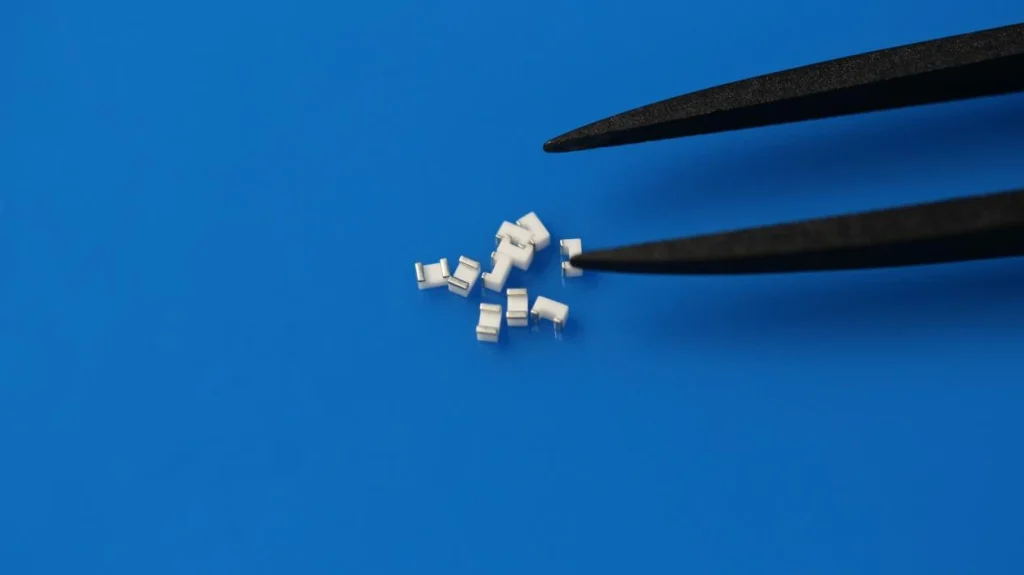
U-Shaped Alumina Ceramic Base
1. The Role of a Ceramic Base in SMD Fuses
In an SMD fuse with a separate ceramic base, the ceramic component does more than enclose the internal parts. It helps maintain the intended geometry of the fuse, separates conductive areas, and supports the electrical connections required by the design.
Electrical Insulation
The fuse must maintain suitable electrical isolation between conductive components during normal operation and under fault conditions. Alumina ceramics offer good electrical insulation and dielectric properties, making them suitable for separating the fuse element, electrodes, and other conductive structures.
In miniature fuse designs, where internal space is limited, the arrangement of insulating surfaces and metallized areas needs particular attention. Their positions and dimensions must be consistent with the electrical requirements of the finished component.
Mechanical Support and Fuse Element Positioning
The ceramic base also helps hold the fuse element in the correct position during assembly. Depending on the design, grooves, recesses, or other customized features can provide a defined location for the element and help maintain alignment.
Fuse elements differ in size, shape, and configuration, so the base usually needs to be designed around the specific product. Dimensions such as length, width, groove depth, and end geometry may all require adjustment to suit the assembly.
A Foundation for Electrode Connections
Alumina is electrically insulating and cannot serve as a conductive path by itself. Where the design requires electrodes or conductive connection areas on the ceramic surface, metallization can be applied to specified regions to create the required electrical interfaces.
This allows the ceramic base to combine insulating areas with conductive features on a single component, supporting subsequent fuse-element connections and packaging operations.
2. Why 95% Alumina Is Used for SMD Fuse Bases
Alumina ceramics are available in different purity grades, including 95%, 96%, and 99%. The appropriate grade depends on the required electrical and mechanical properties, manufacturing processes, reliability targets, and overall cost.
For some SMD fuses that use separate ceramic bases, 95% alumina offers a practical balance between performance and manufacturing cost. Its established material and processing routes make it a useful option for applications where its properties meet the product’s design requirements.
Electrical Insulation Performance
A fuse base needs to provide reliable insulation under normal operating conditions and during fault-related events. 95% alumina offers good electrical resistivity and dielectric properties, making it suitable for many electronic protection applications.
The ceramic geometry can also be designed to maintain defined insulating regions between the fuse element, electrodes, and other conductive parts. The required spacing and layout depend on the fuse’s electrical ratings and internal construction.
Thermal and Dimensional Stability
When a fuse operates under fault conditions, the region around the fuse element can experience a rapid temperature rise. The base material must be able to withstand the associated thermal changes without compromising the component’s structure.
Compared with many organic insulating materials, alumina ceramics generally provide higher thermal stability and better resistance to softening or substantial deformation at elevated temperatures.
Alumina also has inherent fire-resistant characteristics. However, a fuse’s breaking capacity and arc-interruption performance depend on several factors, including the fuse element, rated voltage and current, internal cavity, and overall packaging design. These capabilities cannot be attributed to the ceramic base alone.
Compatibility with Precision Forming and Metallization
Small SMD components require more than suitable material properties. Their ceramic bases must also meet dimensional and structural requirements that support repeatable assembly.
Depending on the manufacturing route, alumina can be formed into U-shaped, grooved, recessed, and other customized geometries. Additional precision processing and thick-film metallization can then be used to produce the required structure and conductive patterns for different fuse designs.
3. Why Metallization Matters for Alumina Ceramic Bases
Alumina provides electrical insulation, but a fuse design may also require conductive areas on the ceramic surface for electrode connections. In these cases, metallization creates the necessary conductive layer in designated locations.
A typical process sequence may include:
Alumina ceramic base → Thick-film printing → Metal-layer sintering → Optional surface finishing → Fuse assembly and packaging
The resulting component combines insulating ceramic regions with conductive metallized areas. The specific process and material system should be selected according to the electrode design and the requirements of subsequent assembly.
Thick-Film Printing
The process generally begins with printing conductive paste onto selected areas of the ceramic surface according to the electrode pattern.
For miniature ceramic bases, even small deviations in the metallization pattern can affect assembly alignment and electrical connections. Important control points include:
- Electrode position and alignment
- Size and coverage of the metallized area
- Printed layer thickness
- Pattern continuity and completeness
- Edge definition and quality
Depending on the product design and connection method, conductor systems such as silver (Ag) or silver-palladium (Ag/Pd) may be considered. The final choice depends on compatibility with the ceramic, the required electrical performance, and the subsequent joining process.
High-Temperature Sintering
After printing, the conductive paste is sintered according to the requirements of the selected material system. This step helps form a stable bond between the metallized layer and the ceramic surface.
Sintering conditions vary with paste composition and processing requirements. Published research, for example, describes sintering temperatures around 850°C for certain Ag and Ag-Pd thick-film conductor systems. This should not be treated as a universal production setting: the actual temperature, holding time, and heating and cooling profiles must be established for the specific paste formulation and process window.
Controlling these parameters is important for achieving consistent metallization quality and adhesion.
Optional Nickel or Gold Plating
Depending on the final connection and packaging requirements, the metallized surface may receive additional treatment, such as nickel or gold plating.
Nickel can serve as a protective or barrier layer and help prepare the surface for subsequent joining processes. Gold plating may be selected where the application requires particular surface characteristics or connection performance.
Neither treatment is necessary for every design. The need for plating, the selected coating system, and the coating thickness should be determined by the underlying metallization, the connection method, and the requirements of the finished fuse.
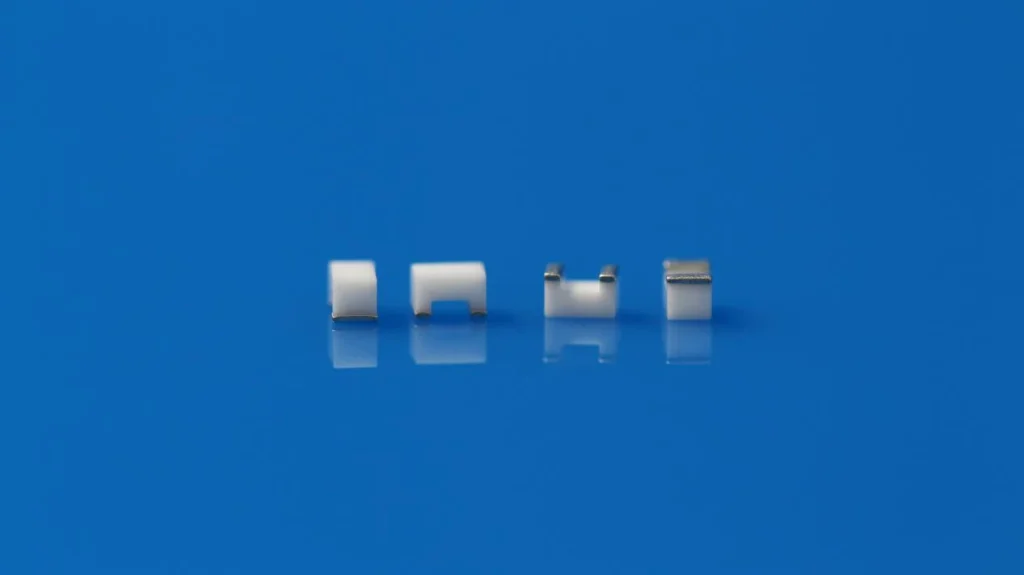
U-shaped Ceramic Base
4. U-Shaped Ceramic Bases and Alternative Structures
The U-shaped alumina ceramic base is one structure used in electronic protection devices. Its central groove provides space for the fuse element, while the ceramic walls on either side offer mechanical support and electrical insulation. Depending on the design, the groove can also help keep the element in position and organize the internal assembly.
However, U-shaped bases are not suitable for every SMD fuse. The required geometry depends on the fuse element, electrical ratings, internal clearances, and packaging method.
Other possible designs include:
- Grooved ceramic bases: Provide a defined channel for positioning the fuse element.
- Recessed or partially recessed structures: Create localized space for specific internal components.
- Multi-groove or separated-channel structures: Accommodate designs with multiple distinct features.
- Flat ceramic substrates: Used where the component layout does not require a raised or grooved structure.
- Other customized ceramic carriers: Developed to meet product-specific dimensional and assembly requirements.
Selecting a suitable structure requires consideration of rated current, rated voltage, breaking characteristics, fuse-element dimensions, available internal space, and the overall packaging method.
For fuses that require more internal space or higher breaking capacity, the package must also account for arc control, heat behavior, and the arrangement of internal components. A smaller or more compact ceramic structure is not necessarily the best choice without considering these factors.
5. Key Manufacturing Requirements for SMD Fuse Ceramic Bases
Producing a metallized ceramic base involves more than forming alumina into the required shape. The ceramic dimensions, metallization quality, and downstream assembly process must work together. In miniature components, inconsistencies in any of these areas can affect assembly yield and finished-product reliability.
Dimensional Consistency
The overall dimensions of the base, groove width and depth, wall thickness, and end geometry all influence fuse-element positioning and assembly.
During production, dimensional tolerances and batch-to-batch consistency need to be controlled. Variations in these features can cause alignment problems or alter the electrical spacing between conductive components.
Metallization Position and Adhesion
The metallized pattern must align with the intended electrode locations. The metal layer also needs sufficient adhesion to the ceramic to reduce the risk of separation or cracking during assembly, joining, and temperature cycling.
For small ceramic bases, consistent pattern dimensions and positioning are particularly important because they directly affect the subsequent electrode connection process.
Matching the Ceramic Structure to the Fuse Element
Fuse elements vary in material, dimensions, and shape. Their selection depends on the fuse’s rated current, rated voltage, and required fusing characteristics.
The ceramic base must accommodate the specific element. Groove width, depth, positioning features, and available internal space should therefore be designed around the intended assembly rather than selected independently.
Compatibility with the Final Packaging Process
The ceramic base is usually one part of a larger fuse assembly. Depending on the product, the finished component may also include end electrodes, a fuse element, a cover, plastic sealing, or other packaging features.
These requirements should be clarified during the ceramic base design stage:
- Fuse-element assembly method
- Electrode connection method
- Welding or other joining processes
- Package and sealing structure
- Surface-mount assembly requirements
- Reliability requirements of the finished product
SMD fuses vary in dimensions, construction, electrical ratings, and assembly methods. A ceramic base may follow an established specification or be customized in its geometry and metallization pattern to suit the specific design.
6. Metallized Alumina Ceramic Base Solutions from INNOVA Supplies
INNOVA Supplies offers metallized alumina ceramic components, including ceramic bases for SMD fuses and other electronic applications. Standard products may be available, and we can consider customization based on customer drawings, dimensions, and metallization requirements.
For U-shaped, grooved, and other non-standard structures, the ceramic geometry, metallization system, and optional surface treatment can be evaluated according to the intended application and assembly process.
If you are sourcing a ceramic base for an SMD fuse, don’t hesitate to get in touch with INNOVA Supplies with your drawings or dimensional requirements to discuss suitable product options and request a quotation.
Email: info@innovasupplies.com