In modern manufacturing and precision fabrication, TIG (Tungsten Inert Gas) welding is widely recognized for its stable arc performance and high weld quality. Because this process relies heavily on consistent shielding gas coverage, the performance of the gas nozzle has a direct impact on arc stability and weld formation. As a key component of the TIG torch, the ceramic gas nozzle is responsible for controlling both the direction and distribution of the shielding gas. With increasingly demanding welding requirements across industries, high-performance ceramic nozzles in multiple specifications have become essential for achieving precise and stable welding results.
High-Temperature Ceramic Materials for Stable Welding Performance
TIG welding generates substantial heat, requiring nozzle materials capable of maintaining stability under prolonged high-temperature exposure. High-quality ceramic gas nozzles are typically manufactured from alumina (Al₂O₃) ceramics formed through high-temperature sintering processes. These precision ceramics offer excellent thermal stability and reliable insulation performance during welding operations.
Compared with metal nozzles, ceramic nozzles provide superior heat resistance and are less prone to deformation or cracking during continuous welding or high-current applications. Their smooth inner surface also helps reduce weld spatter adhesion, making cleaning easier and extending consumable service life.
Multiple Specifications for Different Welding Requirements
1. Nozzle Diameter and Gas Coverage
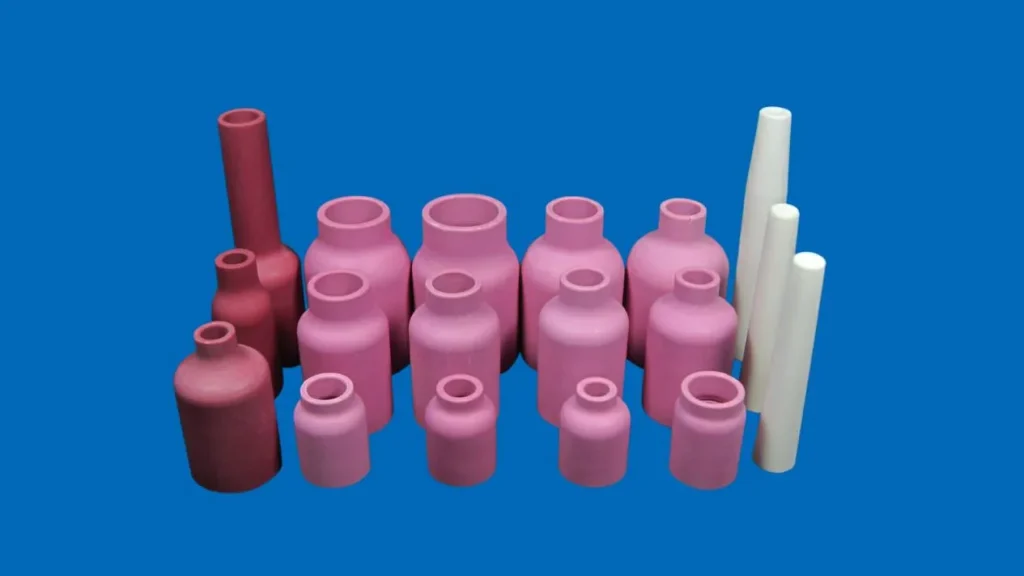
Ceramic gas nozzles are commonly classified according to their inner diameter. Different sizes produce different shielding gas coverage patterns and flow characteristics.
In practical applications, nozzle sizes are usually identified by numbers such as #4, #6, #8, #10, and #12, corresponding to specific inner diameters including 5 mm, 7.5 mm, 8 mm, 10 mm, and 12.5 mm.
– Small-diameter nozzles (#4, #5, #6)
These are suitable for low-current or precision welding applications, including thin-sheet welding and small component fabrication. Their concentrated gas flow allows accurate protection of smaller weld pools and is commonly used for stainless steel tubing, thin-wall structures, and precision assemblies.
– Large-diameter nozzles (#8, #10, #12 and above)
For higher-current welding or applications requiring a broader shielding area, larger nozzles provide wider gas coverage and help form a more stable protective atmosphere. They are often used for materials such as aluminum and titanium alloys, where oxidation control is especially important.
2. Nozzle Shape and Length
In addition to diameter, nozzle geometry and length also influence shielding effectiveness.
– Standard and extended nozzles
For confined structures or deep-groove welding, extended nozzles allow shielding gas to reach deeper weld areas more effectively. This helps maintain arc stability even when longer tungsten electrode extensions are required.
– Optimized structural designs
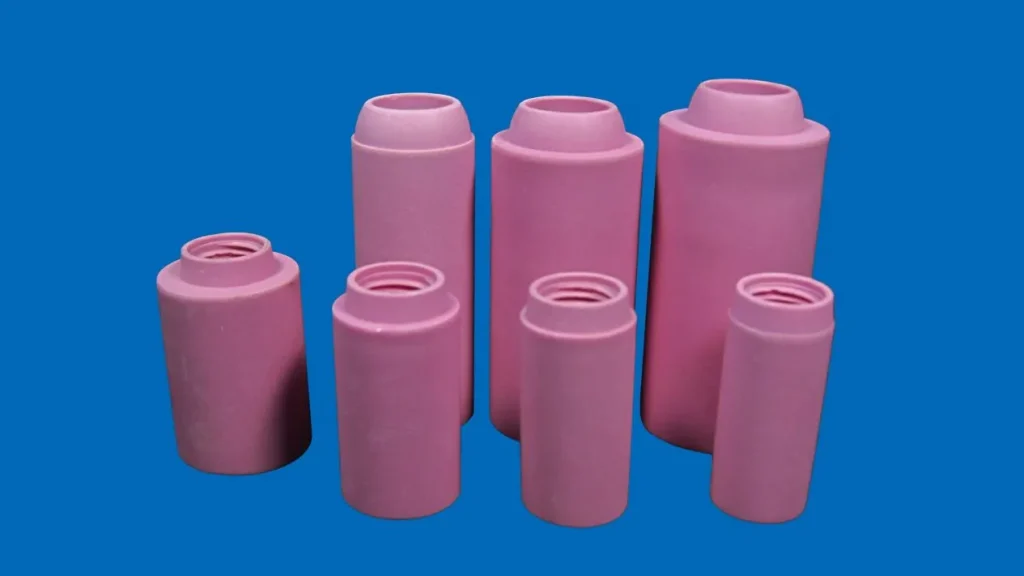
Some ceramic nozzles feature expanded or specially designed cylindrical structures to improve gas flow characteristics and reduce turbulence. More uniform gas distribution helps improve weld consistency and overall weld quality.
Application Areas
Multi-specification TIG ceramic nozzles are suitable for a broad range of welding applications, from precision manufacturing to heavy industrial fabrication.
– Aerospace and high-end manufacturing
When welding titanium alloys, stainless steel, and other high-performance materials, stable shielding gas coverage is critical. Properly selected ceramic nozzles, especially when used with gas lenses, help reduce oxidation and improve weld appearance and consistency.
– Automotive and industrial piping systems
In automotive exhaust systems, pressure piping, and structural welding, nozzle size directly affects shielding performance. Larger or extended nozzles are often preferred for confined or deep-joint welding operations.
– Automated TIG welding systems
In automated welding equipment, including pipe-to-tube-sheet welding and robotic production lines, ceramic nozzles are widely used because of their thermal resistance, insulation properties, and dimensional stability, helping ensure process repeatability.
– Precision welding of small components
For thin materials and compact metal parts, small-diameter nozzles provide concentrated gas protection that supports cleaner weld formation and reduces welding defects.