


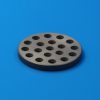
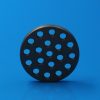
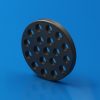

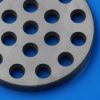
The Silicon Carbide Perforated Distribution Plate is a non-standard industrial ceramic component designed for medium flow distribution, pressure throttling, flow equalization, and gas or slurry rectification in demanding process systems. It is particularly suited to applications involving abrasive, corrosive, or high-temperature media, such as flue gas desulfurization, pneumatic ash handling, SCR denitrification, and power plant slurry systems.
Product Properties
Product Details
The Silicon Carbide Perforated Distribution Plate is a non-standard industrial ceramic component designed for medium flow distribution, pressure throttling, flow equalization, and gas or slurry rectification in demanding process systems. It is particularly suited to applications involving abrasive, corrosive, or high-temperature media, such as flue gas desulfurization, pneumatic ash handling, SCR denitrification, and power plant slurry systems.
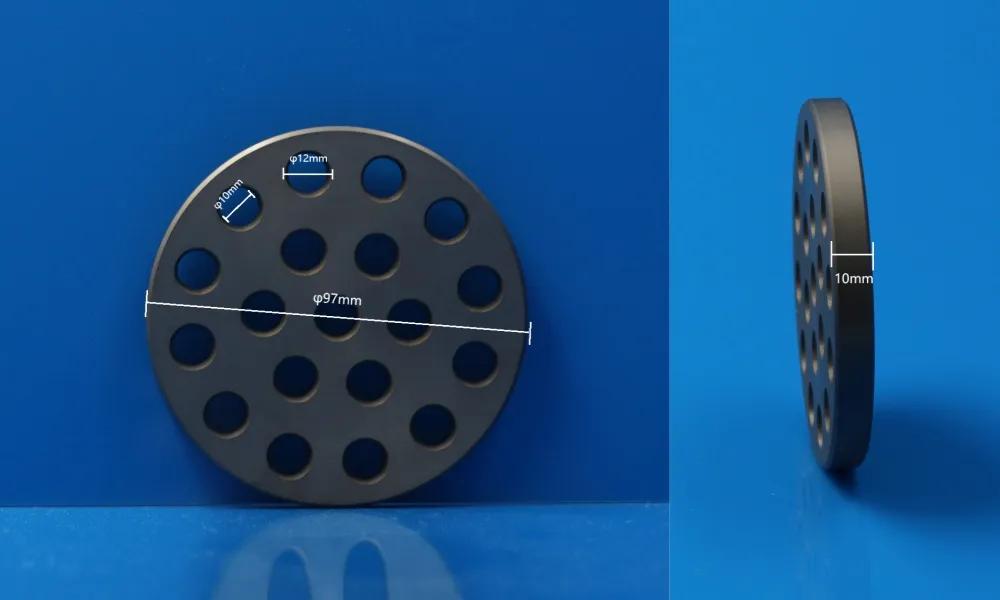
This page features a reference configuration for a perforated distribution plate. Its circular structure and precisely arranged through-holes allow integration into flow distribution and throttling assemblies per the system design.
This product is fully customized and is not available as a standard off-the-shelf component. Dimensions, hole quantity, hole arrangement, hole types, positioning features, spigots, mounting holes, and other structural details can be manufactured according to customer drawings and specific operating requirements. Please contact us with your drawings or application requirements for evaluation.
Technical Specifications
| Parameter | Specification |
|---|---|
| Product Name | Silicon Carbide Perforated Distribution Plate |
| Abbreviation | SiC Distribution Plate / SiC Perforated Plate |
| Product Type | Fully Customized Non-Standard Industrial Ceramic Component |
| Material | Silicon Carbide (SiC) |
| Plate Structure | Integral Circular Disc |
| Number of Holes | Customizable |
| Hole Diameter | Customizable |
| Density | 3.02–3.10 g/cm³ |
| Mohs Hardness | 9.2 |
| Flexural Strength | ≥300 MPa / 480 MPa* |
| Maximum Service Temperature | 1380°C (Air) / 1600°C* |
| Thermal Expansion Coefficient | 4.6 × 10⁻⁶/°C |
| Thermal Conductivity | 170 W/m·K |
| Thermal Shock Resistance | 400°C (ΔT) |
| Corrosion Resistance | Resistant to acid, alkali, chloride, and sulfate media |
| Surface Smoothness | High finish; not easy to scale and block |
| Outer Diameter | 50–1200 mm |
| Oversized Structure | Split structure available for oversized plates |
| Plate Thickness | 10–60 mm |
| Thickness Selection | Customized according to pressure resistance and erosion conditions |
| Hole Diameter Range | 3–50 mm |
| Hole Type | Straight hole / tapered hole |
| Hole Quantity | 1–100+ |
| Hole Arrangement | Circular array/matrix layout |
| Flatness | ≤0.05 mm (precision-ground surface) |
| Installation Structure | Plain disc / stepped disc/disc with positioning holes |
| Installation Matching | Fully matched with customer flange and cavity dimensions |
Shipping & Customs
Your order may require payment of import duties or other customs clearance fees. Please check the notifications from the logistics company or relevant parties and complete the payment in time to prevent the shipment from being returned.
Frequently Asked Questions
Silicon carbide combines high hardness, wear resistance, corrosion resistance, and thermal stability, making it suitable for distribution components exposed to abrasive particles, corrosive media, and demanding operating conditions.
Silicon carbide has good resistance to many acidic and alkaline media, as well as chloride- and sulfate-containing environments. Actual chemical compatibility should still be evaluated based on the slurry composition, concentration, temperature, and operating conditions.
Silicon carbide offers substantially higher hardness and good corrosion resistance compared with many conventional metal materials. This can make it a suitable material option where abrasive wear and chemical corrosion are important concerns.
The appropriate SiC grade and operating conditions should be considered together when evaluating high-temperature service. Actual performance depends on the surrounding atmosphere, temperature, thermal cycling, mechanical loading, and contact with the process medium.
Silicon carbide has high hardness and good wear resistance, making it suitable for applications involving abrasive particles such as ash, solids, or mineral-containing slurry. The actual service life depends on particle concentration, particle size, flow velocity, and operating conditions.
The material should be evaluated based on the process medium, chemical composition, particle content, operating temperature, pressure, flow conditions, and expected wear. Providing these operating conditions together with the component drawing allows the material and design to be evaluated more accurately.
Related products
Original price was: $9.72.$8.75Current price is: $8.75.

Price range: $130.00 through $255.00
Original price was: $361.11.$325.00Current price is: $325.00.
Original price was: $39.44.$35.50Current price is: $35.50.
My History
No products in history.